Privacy-Preserving Recommender System
A recommender engine that preserves user privacy through federated and encrypted techniques while delivering personalized suggestions.
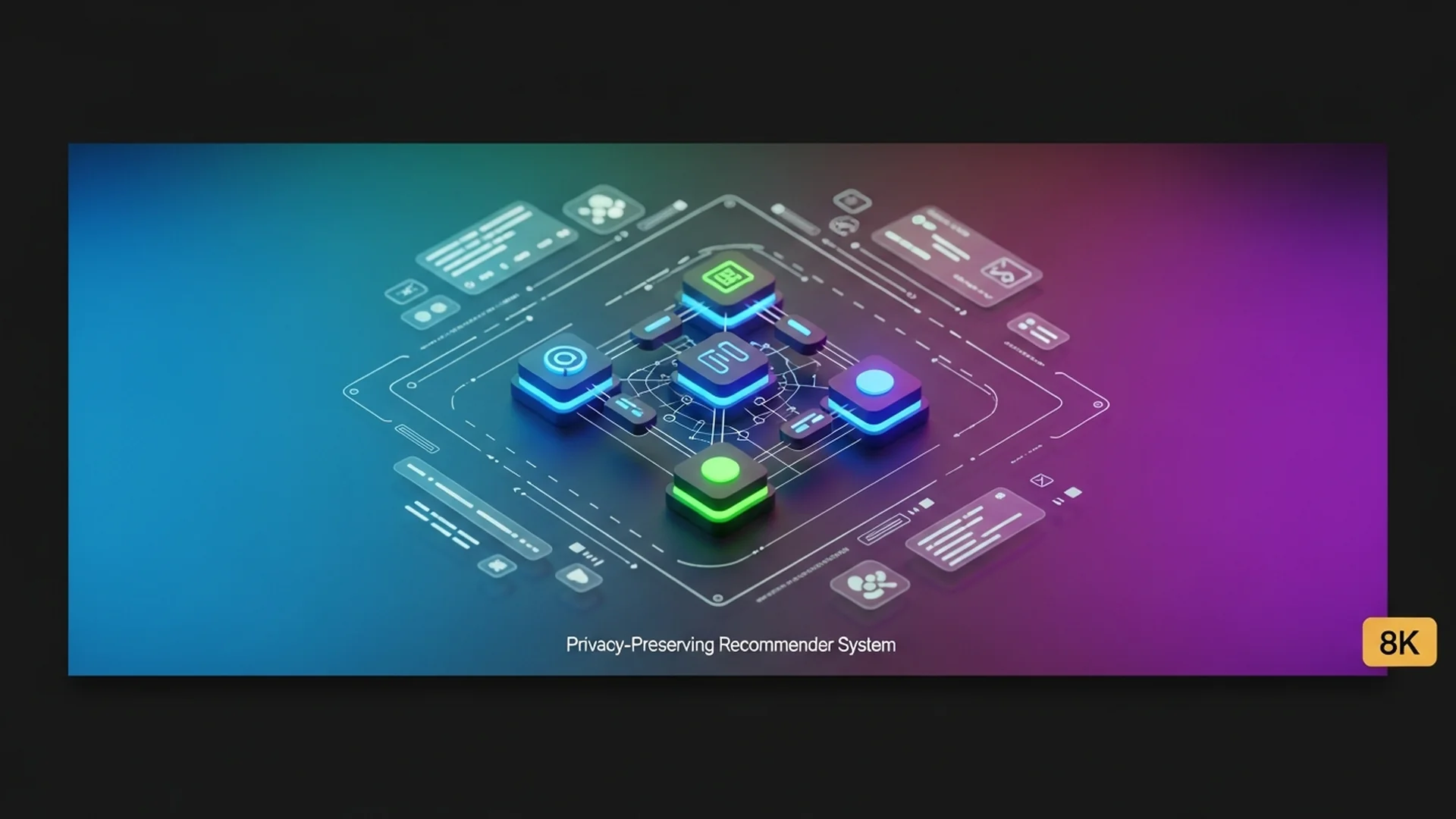
Personalization is critical for modern apps, but collecting and centralizing user behavior data poses privacy and compliance risks. The Privacy-Preserving Recommender System project demonstrates how to deliver accurate recommendations using a combination of federated model updates, on-device embeddings, and encrypted aggregation. This design minimizes data movement while keeping personalization performant for mobile and web platforms.
SEO keywords: privacy-preserving recommender, federated recommender, on-device embeddings, private personalization, secure recommendations.
Key capabilities include on-device representation learning for users, periodic encrypted model updates aggregated server-side, and a hybrid serving model where coarse personalization runs on-device and refined scores are produced server-side without exposing raw behavior logs. This hybrid architecture balances privacy with recommendation quality.
Benefits and implementation highlights:
- On-device embeddings: user interactions are converted into compressed embeddings stored locally and used for nearest-neighbor matching for fast, private recommendations.
- Federated updates: local models are updated and aggregated using secure protocols to improve a global model without sharing raw events.
- Differential privacy: aggregate updates are noise-injected where necessary to provide provable privacy guarantees.
- Cold-start strategies: a privacy-conscious cold-start uses anonymized cohort-level signals to provide initial recommendations without personal data.
Feature summary table:
| Feature | Benefit | Implementation |
|---|---|---|
| On-device matching | Instant personalization | ANN on mobile / local index |
| Secure aggregation | Privacy-safe learning | Encrypted updates + DP noise |
| Hybrid serving | Best of both worlds | Local + server-scored passes |
| Explainability | User trust | Local explanations & transparency UI |
Implementation steps
- Implement local embedding pipelines in mobile SDKs and a simple local ANN index for nearest-neighbor queries.
- Create a federated training orchestration to pull model deltas from clients and securely aggregate them on the server.
- Add differential privacy controls and tune noise levels for a balance between utility and privacy.
- Deploy hybrid serving that first queries local recommendations, then optionally refines with server scores if allowed.
- Provide user-facing controls and transparency about what data is used for personalization.
Challenges and mitigations
- Utility vs. privacy trade-offs: systematic experiments measured accuracy drop due to DP noise; we adapted by increasing local context and smarter compression.
- Device heterogeneity: varied devices required adaptive computation budgets and compressed update formats to reduce upload sizes.
- Explainability: presenting why a recommendation was chosen without exposing other users required cohort-level signals and local attribution techniques.
- Operational complexity: federated orchestration and secure aggregation added infra overhead, mitigated by reusable orchestration components and libraries.
Why this matters now
Legislation and user expectations now demand transparent, privacy-first personalization. This project provides a reusable blueprint for building personalization that respects privacy while delivering business outcomes like higher engagement and retention. From an SEO standpoint, content about privacy-first recommender architectures, federated learning for personalization, and compliant personalization strategies attracts engineering and product teams planning ethically-sound recommendations.